All Categories
Featured
Table of Contents
Reinforcing security steps is crucial to attend to operational dangers and fulfill compliance requirements. There's no single blueprint for digital transformation. Every organization faces various obstacles, concerns, and chances. But effective strategies do share some common characteristics: they're grounded in service goals, flexible enough to evolve with emerging tech, and customized to a company's people, processes, and market.
Start by identifying the key results you desire to achieve. Are you trying to decrease expenses, grow profits, improve customer experience, or develop more durable facilities!.?.!? The most efficient methods are developed backward from preferred outcomes to the innovations and processes that can provide them. Your technique may include a number of focus locations depending upon what you're trying to accomplish:: Improve processes utilizing automation, cloud migration, and AI-based optimization to minimize expenses and boost speed.
: Introduce new items, services, or shipment models (like digital subscriptions, marketplaces, or self-service platforms) to generate brand-new revenue streams.: Equip employees with digital tools, enable remote partnership, and purchase upskilling to support transformation from within.: Reinforce cybersecurity, enhance compliance, and style systems that are more adaptable and fault-tolerant.
Essential Tips for Building Smart Innovation
: Usage KPIs tied to both company efficiency and technical impact.: Start with pilot programs or "quick wins" that can be scaled up when validated.: Assign ownership and accountability to cross-functional leaders who can drive the change.: Be prepared to pivot as innovations shift and customer expectations develop.
: might focus on patient access and remote tracking. A digital transformation strategy isn't a checklist it's a vibrant approach that links where your company is today with where it needs to go.
Digital change methods are increasingly shaped by the larger shifts occurring around us. Much of today's efforts can be traced back to the COVID-19 pandemic, which basically altered how individuals work, shop, and engage. What began as a workaround during lockdowns is now deeply deep-rooted. There's still high demand for remote work, digital cooperation, and smooth online experiences, whether it's virtual healthcare, digital banking, or on-demand services.
Smart Foundations for Next-Gen Digital Success
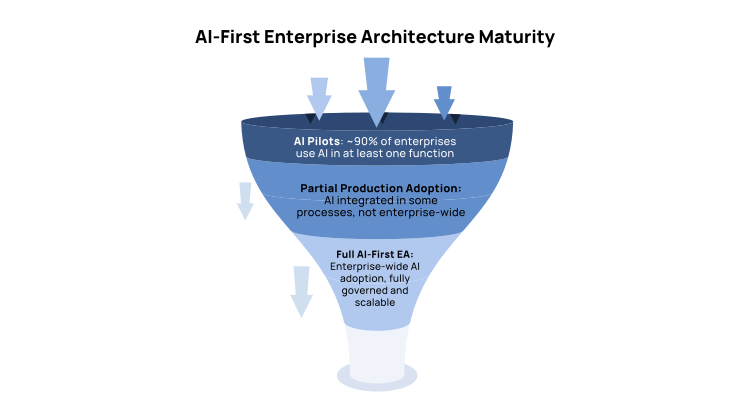
Organizations have had to reassess their operations and offerings to fulfill this brand-new truth: strategies must reflect that shift. At the exact same time, expert system (AI) has actually moved from being a buzzword to an important part of digital transformation strategy. Roughly 75% of all organizations are currently using AI in some capacity, and that number will grow.
The most reliable change techniques now deal with AI and post-pandemic habits not as momentary patterns, but as long-term motorists of innovation. Start by focusing on service impact, not innovation for technology's sake.
However don't overlook people: support, training, and buy-in are what eventually turn plans into progress. Digital improvement takes place throughout every market, from retail and logistics to health care and government. To see this in action, let's explore two extremely different examples. Once an eCommerce shop, Amazon has become a tech giant spanning retail, cloud computing, streaming, and clever home innovation.
Optimizing Cloud Architectures in Modern R&D
Launched in 2005, Amazon Prime reset consumer expectations for online shopping, making quick, trustworthy, low-priced shipment the brand-new requirement. These robotics manage tasks like finding, recovering, and transporting inventory, enhancing effectiveness and allowing over 700,000 employees to move into higher-value roles.
Uses robotic arms, cameras, and sensors to effectively load shipment cars. An AI-powered system that optimizes shipment routes and powers real-time consumer tracking. Digital transformation isn't limited to private companies. The UK's National Health Service (NHS) has actually made significant strides in updating client care. Historically, booking a GP consultation included calling during a brief morning window a procedure that was infamously out-of-date and disappointed many patients.
Video consultations ended up being standard, lowering the requirement for in-person sees while improving benefit for clients. A number of hospitals launched "virtual wards," where patients with persistent or less acute conditions might be from another location kept an eye on through wearable gadgets that track essential signs. This enabled them to remain in your home maximizing hospital beds for more immediate cases and assisting staff focus resources more successfully.
Scaling Robust Smart Hubs for 2026
Technologies progress. Customer and staff member expectations shift. And businesses that stall run the risk of ending up being out-of-date. Whether you're streamlining operations, boosting customer experiences, or updating your facilities, the objective stays the exact same: to adapt, enhance, and stay pertinent. By remaining on top of market patterns and the innovations improving them, you can build a company that not only keeps up but likewise leads the method.

Latest Posts
Enhancing Global Infrastructure for Innovation
Shortening Product Cycles in Enterprise R&D
Essential Technical Insights for Building Innovation